
Canon EOS 200D,Reviews,Performance

Bearing the distinction of the world’s lightest APS-C DSLR with a vari-angle screen, the Canon EOS 200D slots into the manufacturer’s range of DSLRs between the entry-level EOS 1300D and the more advanced EOS 760D and EOS 800D models. It’s a camera aimed at those looking to purchase their first DSLR as well as people who’d like to learn more about photography and develop their skills beyond the limitations of a camera phone or basic compact camera.
Canon has done away with the 18MP APS-C CMOS chip as used in the EOS 100D and has replaced the EOS 200D with a 24.2MP APS-C CMOS sensor. This sensor is identical to the one used inside the EOS 77D and EOS 800D, and works in tandem with Canon’s latest DIGIC 7 image processor. A quick peek at its spec reveals the new processor has improved the continuous shooting speed, albeit marginally to 5fps, which is 1fps faster than the EOS 100D.
As well as offering the full manual shooting control you’d expect from a DSLR, the Canon EOS 200D offers good options for any newcomer to photography in the shape of a Scene Intelligent Auto mode, a selection of Creative Filters, as well as 11 scene modes. All of these beginner-friendly modes are easy to access directly from the mode dial.
The shutter speed range spans from 30sec-1/4000sec and, as with most of Canon’s entry-level DSLRs, you only get a single scroll dial on the top plate. Those wishing the make quick adjustments on the fly will appreciate the impressive 3-inch, 1040k-dot vari-angle touchscreen at the rear. Above the screen you get an optical viewfinder. Although coverage isn’t a full 100%, at 95% it’s respectable for a camera aimed at beginners, and benefits from dioptre correction and depth of field preview.
There’s also a built-in flash that has a guide number of 9.8 (ISO 100), and a flash recycle time of 3 seconds. Naturally, those who require a bit more power can always attach a Canon’s EX series Speedlite or trigger wireless flash via the hot shoe.
Canon EOS 200D – Build and design
Canon has made quite a few changes from the 100D across the body, some of which are more obvious than others. One of the noticeable differences is the material used around the handgrip. The rubberised texture is smoother and not as grippy as it was on the EOS 100D.
Personally, I liked the EOS 100D’s handgrip from a feel and handling perspective, however it never matched any other Canon DSLRs in this respect. The leatherette finish of the Canon EOS 200D’s grip doesn’t offer the same level of grip as its predecessor, but is more consistent with other models Canon produces and looks more stylish.
The polycarbonate resin and carbon-and-glass-fibre body is adequately strong enough to shake off the occasional bump or knock it might receive in day-to-day use. Don’t expect it to be as robust as more expensive models in Canon’s range, though – pick up the EOS 77D or EOS 80D after handing the EOS 200D and you’ll immediately feel the difference in build quality.
I have briefly touched on the fact that it’s a small camera, but its physical dimensions are very slightly larger than the EOS 100D’s. It measures 122.4×92.6x 69.8mm opposed to 116.8×90.7x69mm. I should also point out that it is smaller than Canon’s EOS 1300D and it’s a camera you’ll really want to get in your hands first to find out if it’s going to be the right choice for you.
As for the build quality of the EF-S 18-55mm f/4-5.6 IS STM lens that comes with the camera as part of the basic kit, it’s about as good as one would expect for a kit lens that’s designed to get you started. It doesn’t have a metal mount and isn’t the retractable type, but its optical image stabiliser is effective at keeping handheld shots free of handshake and it doesn’t add much bulk to the camera.
Canon EOS 200D – Viewfinder and screen

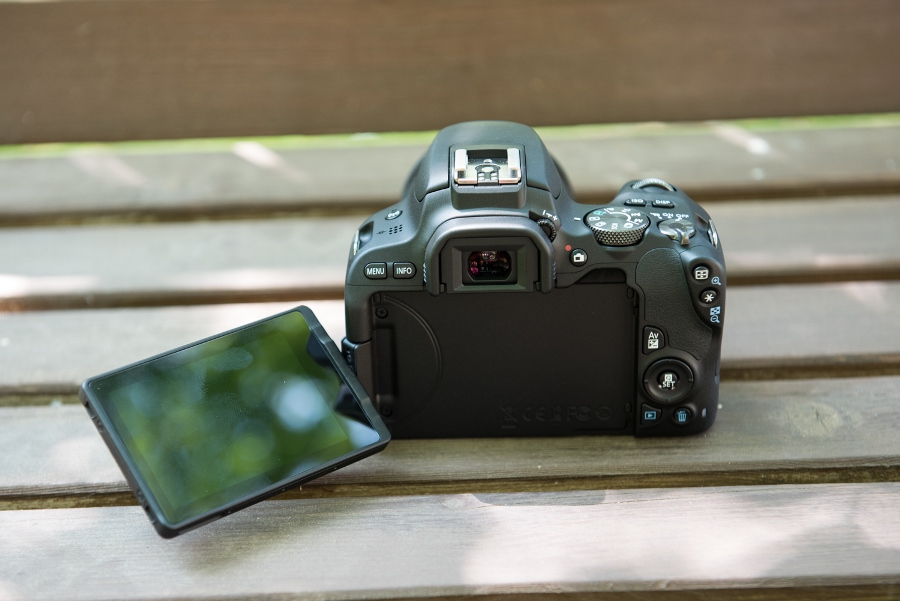
Vari-angle screens have always typically been found on more advanced models in the EOS lineup, so it’s refreshing to see one introduced on the entry-level EOS 200D. It’s one of the major advancements over the EOS 100D and makes it a real pleasure to use when composing images from almost any angle or position.

It takes the pain and hassle away from crawling on your knees or randomly aiming to get a shot only to later find it was taken askew. A small notch has been cut out of the body just below the Live View button to make it easy to pull out, and the good news is that the screen sits virtually flush to the back of the camera when it’s pushed back in.
Touch control of the screen also comes into its own for inspecting images in playback mode where you can use pinch and zoom gestures like you would on a mobile device to zoom in. You can also double-tap the screen in playback to instantly pull up a magnified view, while hitting the Q button in playback opens a range of options such as being able to rate, resize and rotating images
Canon EOS 200D – Autofocus
Raise the viewfinder to your eye, or hit the AF point selection button when the screen is active, and you can view the sum total of 9 AF points on offer.
One AF point is found above and below the central cross-type point with a pair of AF points offset either side. The furthest two AF points on the left and right of the frame can be quickly selected from the central AF point using the left and right directional buttons from the D-pad.
To toggle between manually selecting the AF point and automatic selection mode simply hit the AF point selection button followed by the Q/Set button. Unlike some Canon DSLRs that let you assign the D-pad buttons to shift the AF point straight away without using the AF point position button first, this isn’t possible on the EOS 200D.

Though some may be sceptical of the low number of AF points, they are spread fairly widely across the frame. Testing the camera in a challenging low-light scene revealed that the centre cross-type AF point is by far the most accurate at acquiring focus quickly, so you may find yourself half depressing the shutter to focus before reframing from time to time.
Canon EOS 200D – Video
The EOS 200D doesn’t support 4K-movie recording, however those who enjoy shooting the occasional video can do so at Full HD (1920 x 1080) quality at up to 60fps. Other available frame rates include 50fps, 30fps, 25fps and 24fps. A glance at the left side of the body reveals there is a 3.5mm stereo mini jack should you wish to plug in an external microphone and improve the quality of audio.
Switching to video mode is easy enough from the on/off switch and the video options you’re most likely to need are easily accessed on screen.
Continuous focusing (Servo AF) can be turned on and off from the bottom left corner, there’s the option to magnify the screen feed up to 10x from the lower right corner to aid manual focusing and you can adjust the exposure compensation by up to +/-3EV during recording. The quick menu up at the top right offers access to other important video settings such as movie record size, video snapshot mode, pictures styles, creative filters and white balance.
One feature that we’ve seen added to many Canon DSLRs of late is 5-axis digital stabilisation for video, however this advanced feature isn’t present on the EOS 200D. Users will want to bare in mind that it’s not as easy to create shake-free footage without additional support as it is with a more advanced models like the EOS 800D or the EOS 77D.
Canon EOS 200D – Image Quality
The image quality results from the EOS 200D are very similar to those generated by the recently reviewed Canon EOS 800D and EOS 77D. This isn’t a huge surprise given that the EOS 200D uses the same sensor alongside the same DIGIC 7 image processor. Unlike some of its competitors, the EOS 200D’s sensor retains an optical low-pass filter and the increase to 24.2-million pixels sees it resolve slightly finer detail as well as return higher dynamic range figures across its sensitivity range compared to its predecessor. The noise performance is particularly impressive, with ISO 6400 being eminently useable in low-light situations.




Canon EOS 200D – Performance
Investing in your first interchangeable-lens camera is a big decision to make. Two of the key things you’ll want to look for are a reliably performing camera that’s well supported by a wide range of lenses and accessories. The Canon EOS 200D delivers in both these respects. It put in a trustworthy performance during testing and I didn’t witness anything to say it won’t provide excellent reliability or last a long time in the hands of those who care for it.
If you know you’re going to be using your camera a lot in the great outdoors where there is the chance you might be caught out by inclement weather you will want to make previsions to ensure it doesn’t get wet or damp. Unlike more senior models such as the EOS 80D, the EOS 200D doesn’t feature a weather-sealed construction.
The EF-S 18-55mm f/4-5.6 IS STM lens that you can buy with the camera is as good a place to start as any for a beginner, however it won’t take long before you reach its limitations. If you’d prefer a bit more reach to zoom in closer to distant subjects you may want to give the 18-55mm kit lens option a miss and settle for the EF-S 18-135mm f/3.5-5.6 IS STM bundle instead. It’ll save you looking for a second lens almost straight away after buying the camera, but does require you to pay an extra £240 for the privilege. Like the 18-55mm kit lens, the stepper motor (STM) allows for perfectly smooth transitions of focus when shooting. Not only that but the motor is completely silent, removing any threat of a noisy focusing affecting video audio.
The EOS 200D will perform well in the hands of the beginners and novices it’s aimed at. It would have been good to see it shoot a larger number of raw files at 5fps before the buffer was full, but there are other models such as the Canon EOS 800D that perform better in this respect. The autofocus performance in Live View is where it really excels over the EOS 100D and there’s currently no entry-level DSLR with a better vari-angle screen than you get on the EOS 200D.
Camera Features
| ● Auto Focus | Yes |
| ● Metering | Evaluative/ Center-weighted average/ Spot |
| ● Face detection | Yes |
| ● Continuous shoots | Max. approx. 5.0 shots/sec |
| ● Digital zoom | Approx. 3x - 10x |
Category Type
| ● Model Number | IXUS 190 |
Resolution
| ● Resolution | 24.2 MP |
Video Resolution
| ● Video display resolution | 1280 x 720MP / 640 x 480MP |
Image Sensor
| ● Sensor size | 1/2.3 inch |
| ● Sensor type | CCD |
External Memory
| ● Upgradable Memory | 128 GB |
| ● Memory card type | SDHC |
Flash Properties
| ● Flash range | Approx. 9.8 / 32.1 (ISO 100, in meters/feet) |
Built-in Camera Features
| ● Built in flash | Yes |
Shoot modes
| ● Flash modes | Auto |
Certifications and Standards
| ● ISO rating | ISO 100 - ISO800 |
Timer Features
| ● Self timer | Yes |
| ● Self timer (sec) | 10-sec. |
| ● Time Delay | 2-sec |
Audio Device Height Dimensions
| ● Height (mm) | 95.3 |
Headset Width
| ● Width (mm) | 56.8 |
Audio Device Depth Dimensions
| ● Depth (mm) | 23.6 |
Dimension and Weigth
| ● Weight (g) | 137 (including battery & memory card)/ 122 (camera body only) |
After Sales Service
| ● Warranty | 2 Years Canon India Warranty |
Lens
| ● Focal length | 4.3 (W) - 43.0 (T) mm |
| ● Shutter Speed | 1 - 1/2000sec/ 15 - 1sec (in Long Shutter mode) |
Camera Optical Zoom
| ● Optical zoom | 10x |
Display Features
| ● LCD Size | 3 inch |
Image Resolution
| ● Image display resolution | 230000 dots |
Ports
| ● VGA | Approx. 9Mbps(Standard); Approx. 3Mbps(Light) |


0 Comments